Websites for B&Bs, holiday cottages and campsites.
Guests often find you on a booking site, then look for your own website before they book. If they find it, they can ask you directly. If not, they book through the agent, and the agent takes a cut.
- Bed and breakfasts and guesthouses
- Holiday cottages and self-catering
- Glamping, shepherd’s huts and pods
- Campsites and caravan sites
Guests book on the practical detail.
Lovely photos get someone interested. The booking happens when the practical questions have been answered: how many it sleeps and in what beds, whether the dog can come, whether there’s a phone signal, where to park, what time they can arrive and what the nearest pub is like. Every question your page doesn’t answer is an email, or a guest who quietly goes elsewhere.
So the page is built around those questions, answered in a sentence each, with the photos doing the persuading around them.
What goes on the page.
- Room-by-room photos, with the beds and what is provided for each room
- For self-catering: changeover days, minimum stay and how to check availability
- For B&Bs: breakfast, with what you can do for vegetarians, coeliacs and early starters
- Dogs, hot tubs, wood burners, Wi-Fi, phone signal and EV charging, answered plainly
- Directions, the last mile, where to park and the nearest shop
- The walks, beaches and days out you’d tell a guest about over breakfast
Taking enquiries directly.
The enquiry form’s message box asks for the dates and how many are coming, and comes straight to your email. If you already use a channel manager or a booking calendar, the page links to it. Plenty of owners stay on the big booking sites for the guests who find them there, and use their own website for returning guests and anyone who searches for them by name.
In Scotland, a short-term let needs a licence from the council, and its number has to appear in any advert or listing. If your property is in Dumfries & Galloway, your licence number has a place on the page.
Examples, finished.

Hollin Beck Cottage
A stone cottage for four in Braithwaite, near Keswick. Example business site.
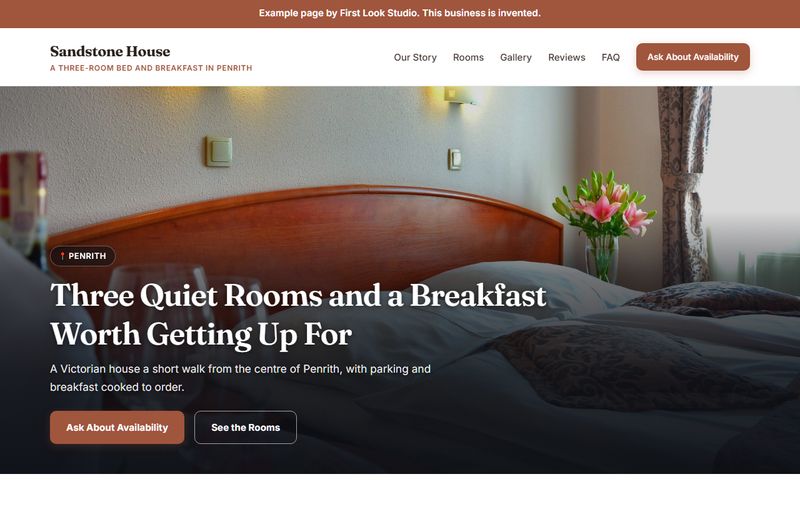
Sandstone House
A three-room bed and breakfast in Penrith. Example business site.
These businesses are made up; the pages are real, built in the studio the same way yours would be. See every example.
What it costs.
One-off build price for a business site, paid only once it has been online for a week and you’ve decided to keep it.
Hosting with your web address included, small changes and a mailbox at that address. Or £150 for a year, paid up front.
No deposit and no card to start. Hosting and web addresses explained.
How it works.
- Sign up freeNo card and no commitment.
- Fill in the designYour words and photos, in the studio.
- Online for a weekI finish it and put it online for you to use.
- Keep it or walk awayPay only if you want it. Otherwise, nothing to cancel.
Questions people ask.
Can it show which dates are free?
If your calendar or channel manager gives you a link or a page to share, your website links to it. The page itself takes enquiries by email rather than payments.
I have two cottages. Do I need two websites?
Usually not. One page can show both with their own photos and details. Ask before you start and I’ll tell you what fits.
Will my photos be good enough?
Phone photos taken on a bright day, with the lights on, work well. While you build it, the studio shows example photos until you add your own, so you can see the layout.
Near the studio.
I’m in Appleby-in-Westmorland, between these four postcode areas. Anyone in the UK can sign up; this is what I know best.
Carlisle & North Cumbria
CA postcodes: Carlisle, Penrith, Appleby-in-Westmorland, Kirkby Stephen and around.
Businesses in Carlisle & North Cumbria →South Lakes & Lancaster
LA postcodes: Kendal, Windermere, Bowness, Ambleside and around.
Businesses in South Lakes & Lancaster →Darlington & the Dales
DL postcodes: Darlington, Bishop Auckland, Newton Aycliffe, Shildon and around.
Businesses in Darlington & the Dales →Dumfries & Galloway
DG postcodes: Dumfries, Annan, Gretna, Lockerbie and around.
Businesses in Dumfries & Galloway →Other kinds of business
- Cafés, restaurants & pubs
- Tradespeople & builders
- Garages & MOT centres
- Hair, beauty & tattoo
- Fitness, health & wellness
- Independent shops & food producers
- Pet groomers, vets & kennels
- Professional services
- Weddings & events
- Lessons & mobile services
- Clubs, community groups & nurseries
- Launch & campaign pages
See your website before you pay for it.
Sign up, pick the design and fill it in. I build it and put it online for a week, and you decide after you’ve used it.